









 Monitoramento da Floresta Amazônica Brasileira por Satélite - PRODES
 Sistema de Detecção de Desmatamento em Tempo Real - DETER


Ayoreo Indians on the future of their uncontacted relatives:
The last six survivors of a genocide, dance:
‘Before we knew it, we’d all caught pneumonia.’ The devastating impact of first contact:
Beast with Metal Skin An uncontacted tribe’s brush with the outside world:
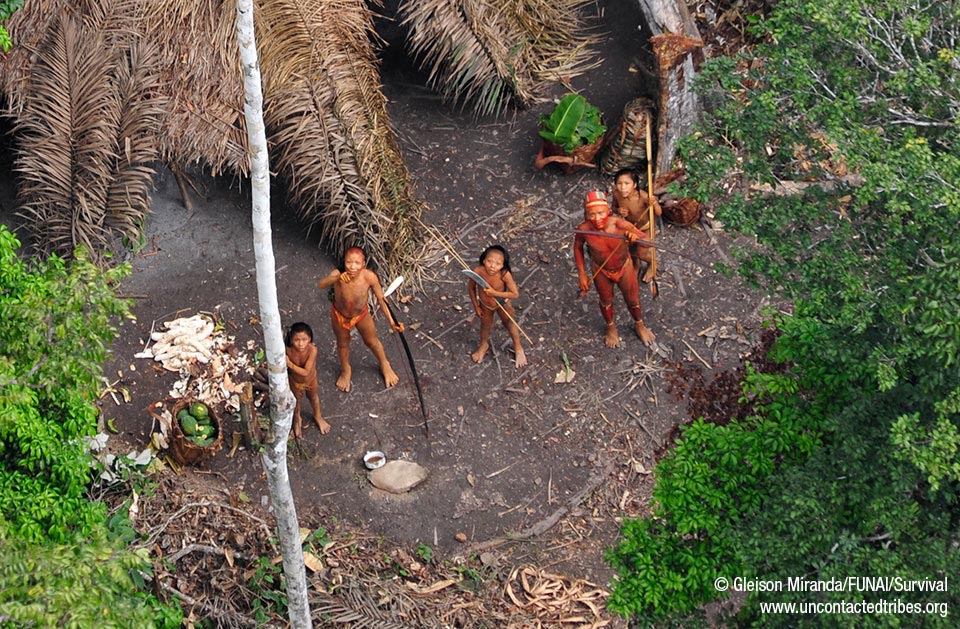
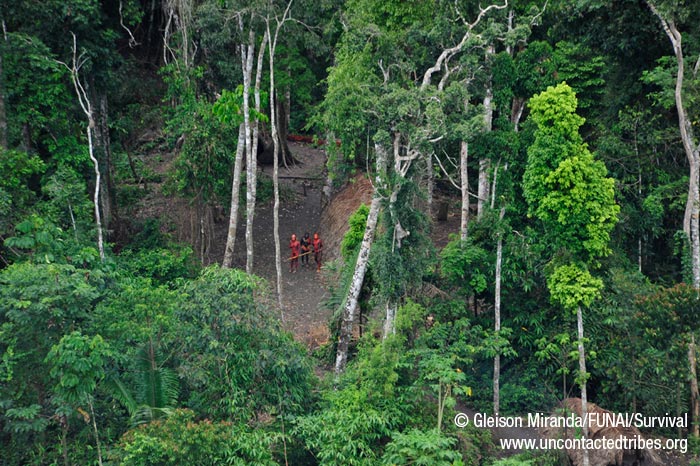
New photos obtained by Survival International show uncontacted Indians in never-seen-before detail. The Indians are living in Brazil, near the Peruvian border, and are featured in the ‘Jungles’ episode of BBC1’s ‘Human Planet’ (Thurs 3 Feb, 8pm, UK only).
The pictures were taken by Brazil’s Indian Affairs Department, which has authorized Survival to use them as part of its campaign to protect their territory. They reveal a thriving, healthy community with baskets full of manioc and papaya fresh from their gardens.
The tribe’s survival is in serious jeopardy as an influx of illegal loggers invades the Peru side of the border. Brazilian authorities believe the influx of loggers is pushing isolated Indians from Peru into Brazil, and the two groups are likely to come into conflict.
Survival and other NGOs have been campaigning for years for the Peruvian government to act decisively to stop the invasion, but little has been done.
Last year an American organization, Upper Amazon Conservancy, carried out the latest of several overflights on the Peru side, uncovering further evidence of illegal logging in a protected area.
Marcos Apurinã, Coordinator of Brazil’s Amazon Indian organization COIAB said today, ‘It is necessary to reaffirm that these peoples exist, so we support the use of images that prove these facts. These peoples have had their most fundamental rights, particularly their right to life, ignored … it is therefore crucial that we protect them.’
Renowned Brazilian Indian leader Davi Kopenawa Yanomami said today, ‘The place where the Indians live, fish, hunt and plant must be protected. That is why it is useful to show pictures of the uncontacted Indians, for the whole world to know that they are there in their forest and that the authorities must respect their right to live there.’
Peru’s Amazon Indian organisation AIDESEP issued a statement saying, ‘We are deeply troubled by the authorities' lack of action… despite complaints from Peru and abroad against illegal logging, nothing has been done.’
TV presenter Bruce Parry of hit TV series Tribe said, ‘Protecting the land where uncontacted tribes live is of global importance. We have consistently failed to introduce them to our world without inflicting terrible traumas. It is for them to decide when they want to join our world. Not us.’
Survival’s Director Stephen Corry said today, 'The illegal loggers will destroy this tribe. It's vital that the Peruvian government stop them before time runs out. The people in these photos are self-evidently healthy and thriving. What they need from us is their territory protected, so that they can make their own choices about their future.
'But this area is now at real risk, and if the wave of illegal logging isn't stopped fast, their future will be taken out of their hands. This isn't just a possibility: it's irrefutable history, rewritten on the graves of countless tribes for the last five centuries.'
fonte
New photos: questions and answers
Who are the uncontacted people in the photos and footage?
Many tribes in this region suffered atrocities during the ‘rubber boom’ a hundred years ago, when wild rubber became an important international commodity. Many were killed or died from disease. However some managed to flee deeper into the forest. The uncontacted Indians living here today may be descended from these people.Why have they painted and decorated themselves?
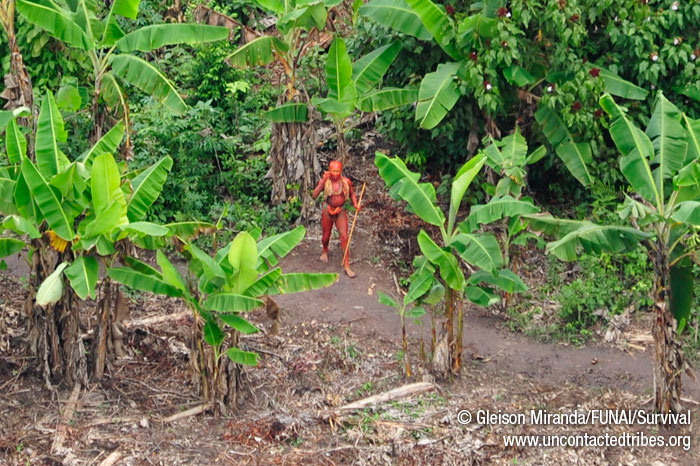
Many South American tribes use body paint as decoration and for other reasons. Red paint (known as urucum) is made from seeds from the annatto shrub. Indigenous people use it to colour things like hammocks and baskets, as well as their skin. (It is also used as a dye by the food industry.) Many Amazon tribes make black dye from the genipapo plant. Some also use crushed charcoal. Black can be used to signal hostility. Like other tribes in the region, the men have shaved their foreheads and have long hair.How can they be filmed if they're uncontacted?
The Brazilian authorities have been monitoring this group of uncontacted Indians for years from the air. Over-flights are used to gather evidence of invasions of their land.Indians certainly hear the plane long before it becomes visible. They will have seen many planes over the years from commercial jets to light aircraft belonging to missionaries, prospectors, and government authorities like FUNAI.
How do these people live? What do they eat? What are the foods visible in baskets?
They probably live in a similar way to many other Amazon Indians. They have cleared large vegetable gardens for fruit and vegetables, and manioc, maize, sweet potato, pumpkin, peanuts, papaya, and bananas can all be identified. They also plant cotton which is spun and woven for skirts. The men have cotton waist bands and some have small head dresses. The men carry bows and arrows for hunting – probably tapir, wild pig, deer and monkeys. No canoes have been seen (many Amazon tribes do not use them), but they probably fish as well.Baskets are made to store vegetables and carry game and fish. (To the left of the main photo there is a pile of manioc or sweet potato, with peelings lying on the ground. The basket is full of papaya. At the entrance to the house are two baskets, one showing a carrying strap. The basket to the far right shows unpeeled tubers – probably manioc. Another is covered with banana leaves to protect whatever food is inside.)
What will their state of health be like?
It is likely to be very good. In the photos the Indians appear strong and healthy and their gardens are full of produce.Why are the photos and video footage being released?
Various government officials in Peru and Brazil have denied the existence of uncontacted tribes and accuse indigenous organizations and their supporters of inventing them. The photos and footage provide clear and compelling evidence that uncontacted tribes do exist. Many tribal people recognize the importance of using the photos and footage to persuade governments to protect uncontacted peoples’ land and to uphold their rights. You can read statements from Yanomami leader Davi Kopenawa Yanomami and from COIAB, the network of indigenous organizations in the Amazon.What next?
Survival is launching an urgent campaign calling on the Peruvian government to expel all loggers working illegally on the land of uncontacted Indians in Peru. Join the campaign.More videos

Beast with Metal Skin
In 1994 a bulldozer driver clearing the forest at night was attacked out of the darkness. Although he didn't know it, he was destroying the gardens and hunting grounds of a group of Ayoreo-Totobiegosode families. One of the Indians, Esoi, was finally forced out of the forest in 2004. Here, he recounts his attack on the bulldozer. 'It was beautiful here'
An Enawene Nawe man tells of his anguish over the deforestation of his tribe's territory by ranchers. 'Blood flows for our land'
Gunmen hired by Paulo César Quartiero, a local farmer and politician, attack a Makuxi Indian community, throwing homemade bombs and firing assault rifles. Ten Indians were wounded. Mr Quartiero was arrested, but released soon after. Warning: this video contains images of violence and injuries which some may find upsetting. Virgin Forest
The Batak of the Philippines reveal the devastation caused to their land by illegal loggers and resin-tapping. 'His voice is not silenced.'
In this emotional interview, Marcos Verón's daughter-in-law tells Survival researcher Fiona Watson how she saw her father-in-law killed. At the end, Verón's widow comes up to embrace Fiona. Poachers
Jarawa denounce poachers who invade their land. This group was filmed as they voluntarily came out of their reserve to complain to local administration officials about the poaching. The Evidence
The Peruvian government denies they exist but the evidence is irrefutable. In this short video Teodoro, a local man, describes his encounter with an uncontacted tribe. 'Our land is our heritage.'
Shaman Davi Kopenawa Yanomami, speaks about what the proposed mining bill would mean for his people. 'We live for our Niyamgiri'
The Dongria Kondh have lived in Niyamgiri for thousands of years and their lifestyle and religion have helped nurture the area’s dense forests and unusually rich wildlife. Vedanta Smokescreen
Just as the pilgrims 'bought' Manhattan from the Indians for a handful of trinkets, Vedanta are trying to cheat the Dongria out of their sacred mountain. Survival's Greenwashing Award
Is presented to Yaguarete Porá S.A. for dressing up the wholesale destruction of a huge area of the Ayoreo-Totobiegosode's forest as a noble gesture for conservation. 


